


Twenty twenty-five has been a year. At UCAP, we were able to attend some great air shows, which got Jack and Jeb in the same Zip Code at the same time, plus we even got to fly together earlier this month on a day trip to Opa Locka, FL. We also looked into the history of and the current political football that is aviation gasoline and tossed some tips your way on resources to help revive old headsets. The January mid-air at DCA and November 4’s FedEx MD-11 crash on takeoff from Louisville, were hot topics, along with much more. As we gingerly peek around the corner at 2026, we wanted to remind you about some of the details 2025 wrought. We might see them again in the near future.
The Year In Review: No Bonus For You
The top aviation story of 2025 has to be the utter chaos reigning throughout the U.S. air traffic control system.
The year started off with the January 29, 2025, mid-air collision of a PSA CRJ700 operating as American Airlines Flight 5342 and a U.S. Army Sikorsky UH-60 Black Hawk helicopter about a half-mile off the approach end of Washington National Airport’s Runway 33. All 67 aboard the RJ and the three helicopter crewmembers were killed; the wreckage of both aircraft fell into the Potomac River.
The accident highlighted, among other things, a growing shortage of controllers throughout the U.S.: A single local controller was talking to both aircraft, but on different frequencies. The NTSB’s investigation into the tragedy remains ongoing, although a preliminary report is available.
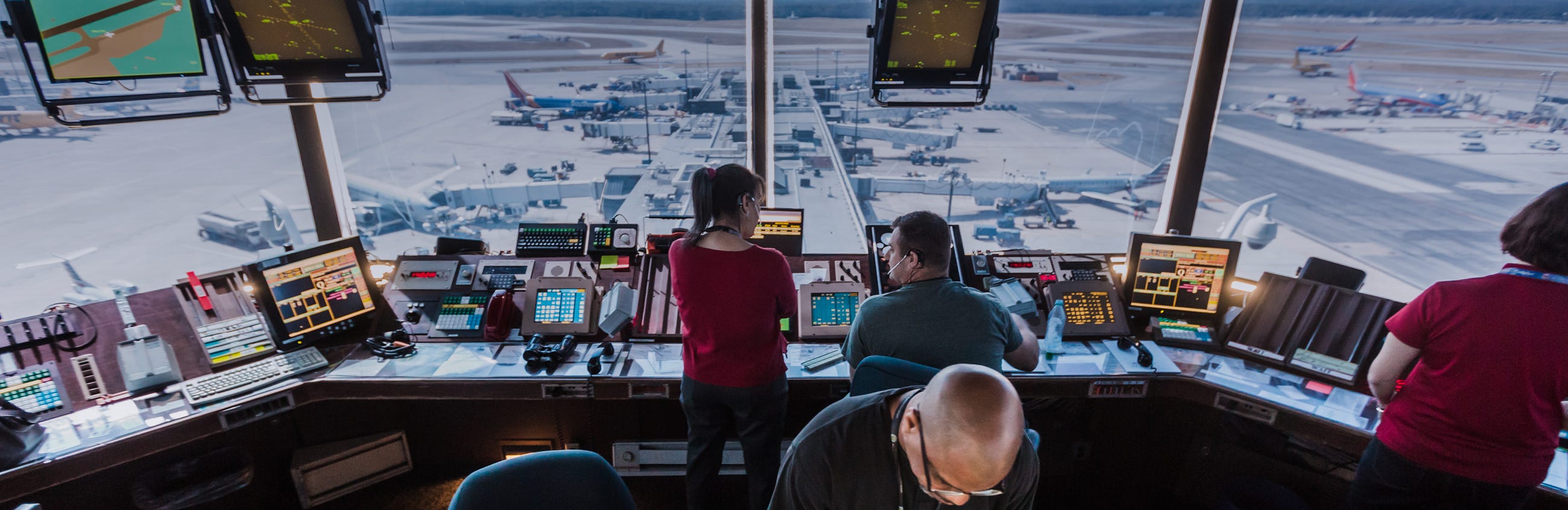
In the immediate aftermath, incoming Transportation Secretary Sean P. Duffy said the DOT and the FAA would take steps toward a modernized ATC system and hire more controllers. It wasn’t long before temporary, intermittent outages began to plague the ATC system, underscoring the need for changes. The outages began affecting New Jersey’s Newark Liberty International Airport (EWR), approach control services for which are remoted to the Philadelphia (PA) TRACON.
On April 28, that facility experienced as much as a 90-second connectivity outage, during which the facility could neither communicate with or see the radar targets it was controlling in the EWR area. The outage was blamed on failed wiring. Another outage occurred at EWR on May 9; the problem then migrated to the Denver ARTCC on May 12. We’re not aware if wiring got the blame again.
“‘If you got 100% on your test, you get the sticker that’s a scratch-and-sniff sticker,’ Duffy said, adding that all the controllers and technicians who were forced to work unpaid would receive full backpay,” the AP reported.
Conveniently, SECDOT Duffy announced an ATC modernization plan on May 8. At the time, the DOT said, “By replacing the current, antiquated system, the FAA will enhance safety in the sky, reduce delays, and unlock the future of air travel. This plan also ensures hard-working air traffic controllers have a system they can rely on and one they deserve.”
“Given the current conditions of the FAA’s infrastructure, we can no longer wait for funding levels to slowly catch up to the need. We need an immediate infusion of funding to address critical infrastructure needs,” the department added. But events conspired against Duffy when the federal government shut down on October 1.
Since controllers (plus other FAA workers and TSA inspectors) weren’t getting paid, staffing shortages started to grow during the shutdown. It got so bad DOT/FAA put into place mechanisms to limit demand at 40 airports around the U.S. and then published NOTAMs closing 12 airports to transient, non-scheduled flights, i.e., GA.
The shutdown ended on November 12, and things have more or less returned to what passes for normal. On December 4, SECDOT Duffy named a so-called “Prime Integrator” to “oversee the rollout of a brand-new air traffic control system to enhance the safety and efficiency of our skies,” noting that $12.5 billion had already been allotted for initial funding.
Peraton, the integrator, is “a privately held American national security and technology company formed in 2017. It is headquartered in Reston, Virginia. Its service areas include space, intelligence, cyber, defense, homeland security, citizen security, and health,” according to Wikipedia. “The company’s expertise with integrating complex tech platforms and successful collaboration with federal government agencies have positioned them well to execute on this ambitious timeline,” the DOT said.
If this was merely a spectator sport, there would be some good news on the horizon: The legislative/political agreement ending the late 2025 shutdown expires on January 30, 2026. While some of this may be entertaining, none of it reflects well on the DOT/FAA or the country as a whole.
As we wrote in a recent issue of Vectors, “One thing the shutdown did seem to accomplish? Angering air traffic controllers, especially after it was announced those who had perfect attendance during the shutdown would receive $10,000 bonuses.” We added, “Those who had long ago scheduled personal time off, experienced a death in their family or were legitimately too sick to work won’t see a penny extra, even if they otherwise worked throughout.”
Just before the shutdown ended, the White House said, “All Air Traffic Controllers must get back to work, NOW!!! Anyone who doesn't will be substantially ‘docked.’”
In a statement to National Public Radio, the National Air Traffic Controllers Association responded, “This nation's air traffic controllers have been working without pay for over 40 days. The vast majority of these highly trained and skilled professionals continue to perform one of the most stressful and demanding jobs in the world, despite not being compensated. Many are working six-day weeks and ten-hour days without any pay.”
According to the Associated Press, “A week after the shutdown ended, the FAA announced only 776 controllers and technicians with perfect attendance during the shutdown would receive bonuses, leaving out nearly 20,000 other workers.”
Also according to the AP, “when asked about the bonuses…Duffy said that both he and the head of the FAA recognize ‘some of the difficult circumstances our controllers were going through’ during the shutdown. But Duffy said a cutoff on the bonuses was necessary.
“‘If you got 100% on your test, you get the sticker that’s a scratch-and-sniff sticker,’ Duffy said, adding that all the controllers and technicians who were forced to work unpaid would receive full backpay,” the AP reported.
Receiving full back pay is not a bonus.
If this was merely a spectator sport, there would be some good news on the horizon: The legislative/political agreement ending the late 2025 shutdown expires on January 30, 2026. While some of this may be entertaining, none of it reflects well on the DOT/FAA or the country as a whole. As we noted, “The bad news is we may get to go through this again in late January, when ‘Fiscal Year 2026 Shutdown II: Electric Boogaloo,’ comes to a screen near you.”
Stand by.
[Jeb]
This newsletter, and the OG audio podcast are, and always will be, free for all. But it takes some time and concentration for us to make them. And we’d like to be able to dedicate even more time and resources to doing them. We’re asking you to consider becoming a financial supporter of what we’re doing.
If you’re unable to make any sort of financial contribution to the UCAP world, we understand. Don’t worry, and please enjoy it all. But if you have the ability to support what we’re doing, please consider doing so.
A monthly donation of as little as $5 — less than a single visit to Starbucks — is a big show of support for what we’re doing. Please go to our Patreon page and do what you can.
Thanks.
Strange Aviation News
The Kolkata Ramp Sentry
In 2012, a Boeing 737, painted in Air India livery, was parked on the ramp at India’s Kolkata Airport. And it just sat there. For 13 years, Kolkata kept adding parking fees to its bill, but no one paid. Nor did anyone come to retrieve the plane. Finally, earlier this year, Kolkata decided enough was enough and contacted Air India, presumably asking them to come get their airplane, and pay the parking fees. But the carrier said they had no record of owning that plane.
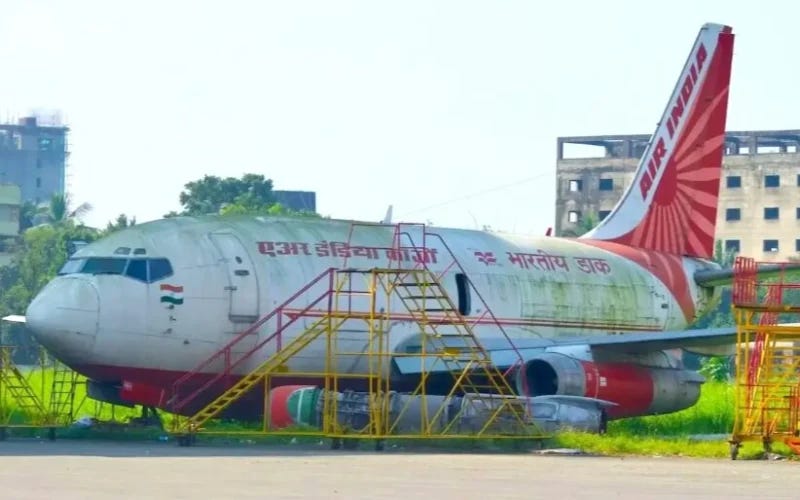
After some investigation, it was discovered that Air India did own the jet, but as a result of staff changes, record keeping modifications, and a couple of corporate mergers, the airframe in question had just gotten bureaucratically forgotten. To their credit, once the lapse was discovered, Air India accepted responsibility for the now-worthless plane. They paid the $120,000 parking bill, and moved the plane to a new location where it’s become a training platform.
The Three Jumbos At Kuala Lumpur
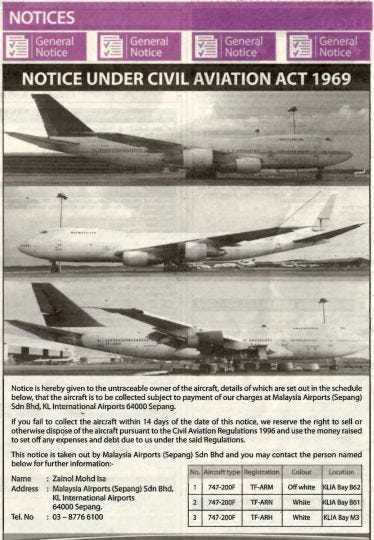
But the Kolkata Air India 737 is not the strangest abandoned plane story. Years ago Malaysia’s Kuala Lumpur airport had three 747s sitting abandoned on their ramp. In 2015, after years of trying to get the owners to remove the planes, the airport published an official notice in the newspapers, pictured above, asking the owners to come forward and take responsibility for the planes, a necessary step leading to the airport taking ownership and breaking them up.
Dude, Where’s My Plane?
The Stinson 108 that landed on a road in the Red Lake Indian Reservation within Minnesota is last we heard still in the hands of the Red Lake Tribe. Tribal leaders have explained that they will consider releasing the plane after an investigation into the event has been completed.
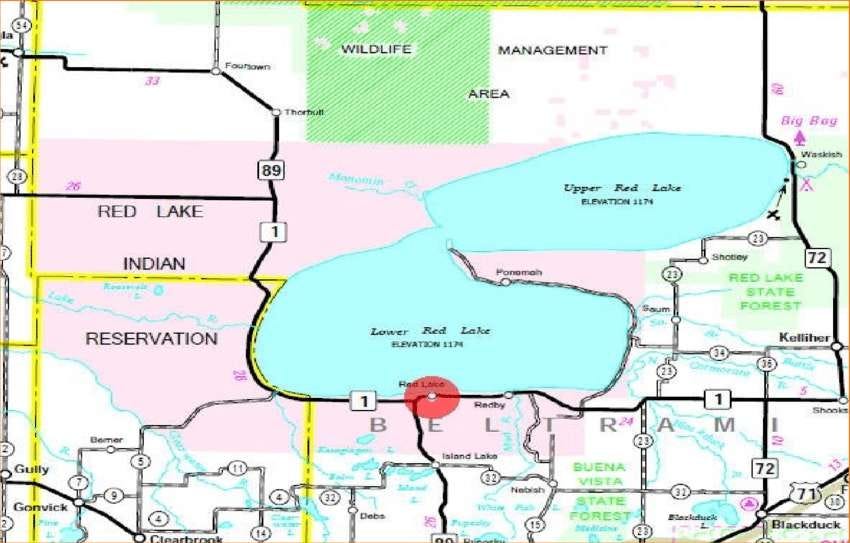
According to local radio station KFGO, “The tribe says it impounded the airplane because it landed on reservation land without prior approval or required coordination with tribal authorities. Tribal leaders added that the landing created immediate safety, liability, and resource-protection concerns for the tribe.”
Various aviation alphabet organizations have been urging the FAA to step in and help the plane’s owner, Darrin Smedsmo, to recover his aircraft. But no joy.
Given what seems to be the tribe’s intransigence in this matter, we’re forced to wonder what the alternate universe would look like if the airplane was, say, a PA-28.
Like Francisco Franco, That Boeing 777 Is Still Valiantly Holding On In Its Fight To Remain Missing
The maritime exploration company Ocean Infinity is slated to return to the Indian Ocean to continue its search for Malaysia Airlines Flight MH370, which disappeared almost 12 years ago. The Boeing 777 vanished from ATC radar systems over the South China Sea about an hour after takeoff from Kuala Lumpur on a scheduled flight to Beijing, China. It was tracked by military radar as a primary return over the Andaman Sea north of Indonesia but that was the plane’s last officially known position. In the aftermath, metadata from the airplane’s satellite communications system was used to project a flightpath into the southern Indian Ocean, but it’s a big ocean.

The private search company will be paid $70 million but only if it actually finds substantial wreckage from MH370.
In Other Federal Transportation News…
U.S. Secretary of Transportation Sean Duffy said in a November interview with Blaze News that the airlines need to be serving better snacks. “I would love a little healthier snack on the airplane,” he told the outlet. In early December, Duffy’s DOT also rolled out a “Make Travel Family Friendly Again” campaign, backed by a $1 billion commitment via a Biden-era infrastructure bill, to address what his department termed “a common refrain from the public – it can be challenging to travel as a family.”
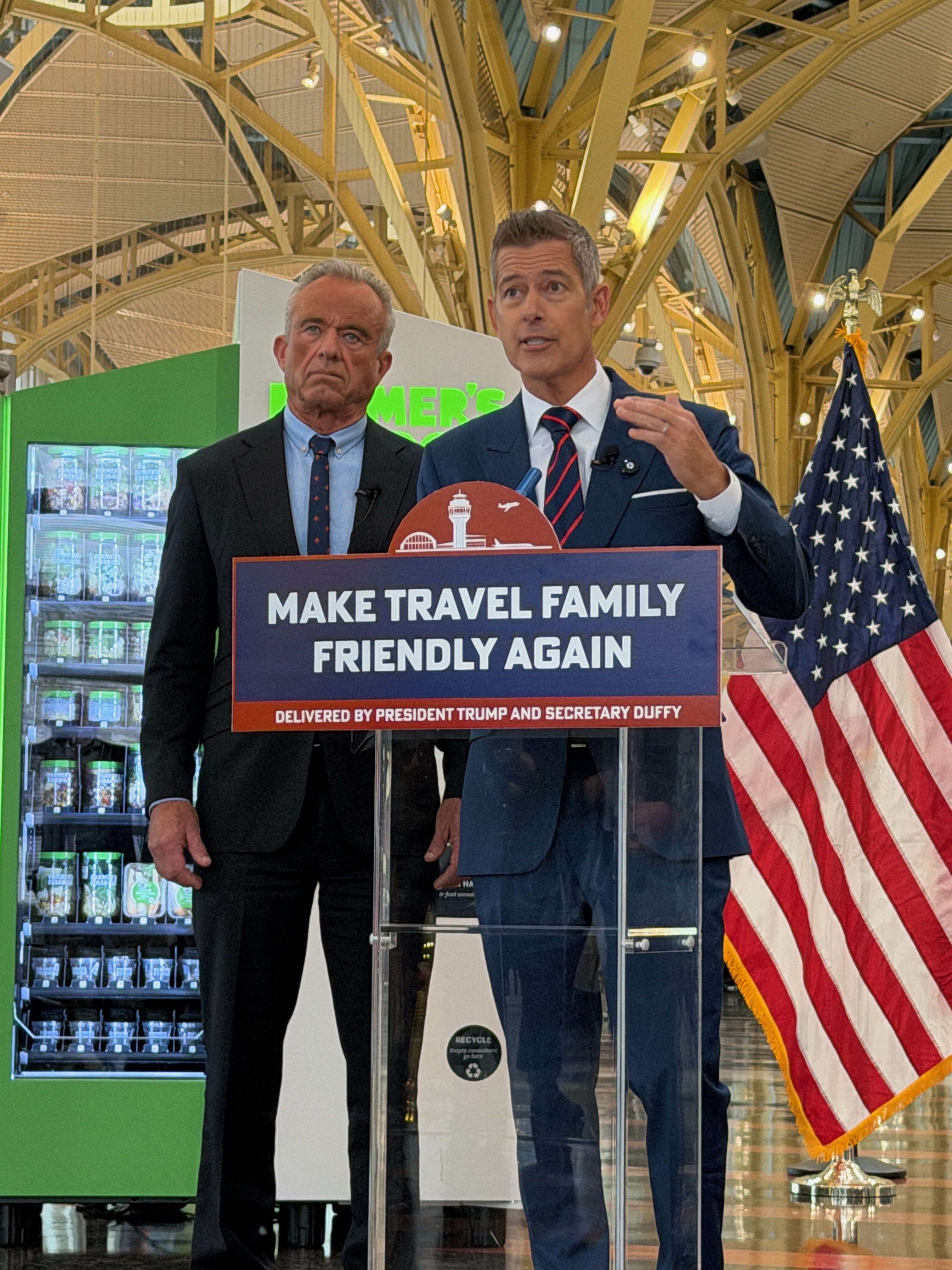
The DOT’s press release noted, “From needing more dedicated spaces for young children and exercise equipment, to finding places for mothers to nurse their children, to staying fit on the go, or struggling to find more healthy food options, the Trump Administration is committed to making every stage of the travel journey more seamless.”
It gets better. “Bringing about a Golden Age in travel has to involve making the family travel experience happier and healthier,” Duffy said in a press release.
“Everyone who passes through an airport in this country should have access to fresh, whole foods,” U.S. Health and Human Services Secretary Robert F. Kennedy Jr. said in the same release. “Secretary Duffy and I are working to ensure our airports set the standard for a future where healthy eating is part of daily life—travel days included.”
Meanwhile, controllers and other workers are finally able to get their finances back in order. You can’t make up this stuff.
[Jack]
Cessna 150 Memories
As I was going through back issues of this newsletter in preparing this one, I came across Jack’s item on the anniversary of his first solo flight. Naturally, that brought back memories of my solo, including the airplane and other reminders. Like Jack, my first solo was in a Cessna 150 — it said “commuter” on the side. It belonged to the local Civil Air Patrol squadron. It cost me $3.25 a Hobbs hour dry; 80-octane avgas was $0.47 a gallon.
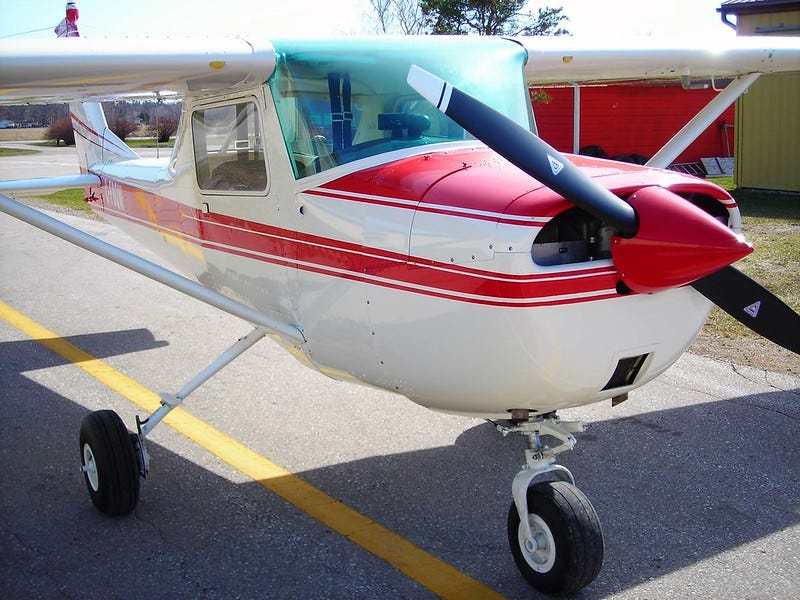
One thing I’ll always remember about 150s: There is no way to ensure the windows and/or doors will always stay shut in flight. In fact, looking back on it, the 150 I soloed seemed to have a MTBWO (mean time between window openings) of about 2.5 hours. Sure enough, that statistic was proven on my third takeoff. I needed three hands to manage the yoke, the throttle and the window. Somehow, I survived. When my CFI climbed back in after my landing, he was laughing: “I saw the window pop open; you did fine.” I went on to fly that airplane a lot to build time toward my private certificate, including local practice and my initial cross-country flights.
Did I mention the doors? The right one on a different 150 once popped open right after liftoff. After getting to a safe altitude, we closed it and flew on. I don’t recall the specifics, but it might have been my passenger’s first flight in a personal airplane. Subsequent flights with them were less dramatic.
I’ve flown many other 150s, including the one I flogged up to 10,000 feet for no good reason. It also was the platform — in its 152 Aerobat flavor — when I did spin training many moons ago.
We were flying out of a small operation based at a grass strip. After tumbling my internal gyros a couple of times in the practice area, we headed back to the field only to find a spring shower had come and gone, leaving behind a lot of wet grass and standing water. The instructor made a hot landing from the left seat and ended up locking the brakes trying to stop. I recall looking out the window at the locked-up right main wheel as it sluiced through the water to the end of the runway. We came to a stop a few feet from a fence, then slowly turned around and taxied to the tiedown without a word.
Ah, memories.
[Jeb]
Please look around your seat for any personal belongings before deplaning Vectors 114. Please also tell your friends about this newsletter, and post your comments about these stories and others you’d like to read about here.