
UCAP Vectors 112
Fed Shutdown affects aviation... Bizav show a hit... Jack sees planes in the sky, and he remembers a milestone in his flying journey.


Fall may be the most loved season for many people, but it sure seems to come and go quickly. It feels like summer’s just ended and already we’re looking Thanksgiving in the eye.
While we wait for the cold season to set in let’s take a look at some of the topics Jeb and I are following around the Aviation World.
Shutdown Update: If You Have Time To Spare, Go By Air
As our most-recent issue of Vectors discussed, the federal government is going through yet another uncalled-for shutdown of so-called “non-essential” agencies and services. As one result, few federal employees are being paid, and many programs are in an open-ended hiatus. You may be among the unpaid federal employees, or you may be affected by some other agency in some other way. Or you may not be affected at all, at least so far.
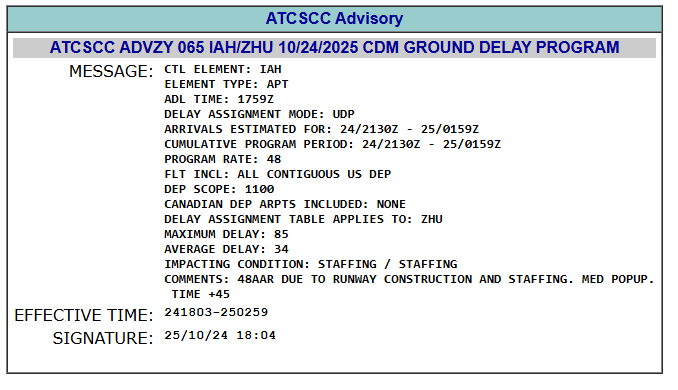
Of course, we’re primarily concerned with the impact on aviation here, and so far, the nation’s air transportation system hasn’t come apart at the seams. However, the signs of strain are there, and growing. For example, see the image above for the relatively benign text of an FAA Air Traffic Control System Command Center (ATCSCC) advisory for arrival delays into Houston’s George Bush Intercontinental/Houston Airport (IAH) in late October.
Behind the scenes, though, there seems to be a lot more drama, at least among rank-and-file employees whose work is considered essential. And it’s growing. One resource is the r/ATC and less-moderated r/ATC2 forums on Reddit.com, where U.S. controllers often vent their frustration over not being paid during the shutdown.
Much of the recent comments in both subreddits have been about changing commitments by the federal government to pay controllers when the shutdown concludes. Others are discussing the ins and outs of calling in sick or even taking vacation, as well as taking on a temporary second job. Complaints about the controller’s union, the National Air Traffic Controllers Association, NATCA, also are growing. Some 13,000 controllers work for the FAA. Before the shutdown, the agency was dealing with a shortfall of about 3500 trained controllers. As icing on the cake, controller training also is on hold during the shutdown.
Delays and uncertainty are the order of the day throughout the U.S. air transportation system. Over the October 25/26 weekend, FlightAware said there were more than 5300 delays on Saturday and at least 2500 by noon eastern time on Sunday, according to the UK’s <i>The Guardian</i>. Meanwhile, about 50,000 TSA officers also must work during the shutdown, and aren’t getting paid either.
When the shutdown will end is anyone’s guess. The 2019 shutdown didn’t end until pilots, controllers and flight attendants got into the action, emphasizing the stresses being placed on the system as a result. If the current shutdown continues through November, Thanksgiving travel promises to be extra special for everyone involved.
Meanwhile, every day should be considered “Be nice to your controller day,” and we’d suggest pilots strive to make the guy or gal’s life on the other end of the mic as easy and stress-free as we can during the shutdown. That could include going VFR when safe and possible instead of IFR, and doing without flight following while en route.
Let’s be safe, careful and patient out there.
[Jeb]
Big Iron Overhead
Where I live here in Dover, New Hampshire, is roughly on the extended centerline from Pease International Tradeport, formally Pease Air Force Base.
Although Pease is primarily a civilian airport these days, it has a US Air Naional Guard unit stationed there. And the runway is pretty long, in fact it was once one of the Space Shuttle’s alternate runways. So this long strip is often used by large and small military aircraft.
As a result, it’s not unusual to see military aircraft in the air over my town.
One day recently, on my walk, I heard a louder than usual aircraft in the sky. I looked up to see a big cargo-looking airplane, with a slightly unusual fuselage shape.
I whipped out my phone for a quick trip into FlightAware to see whether it was showing ADS-B. It was. It was an “A124”, which I initially guessed to be an Airbus, although it didn’t look anything like that airliner.
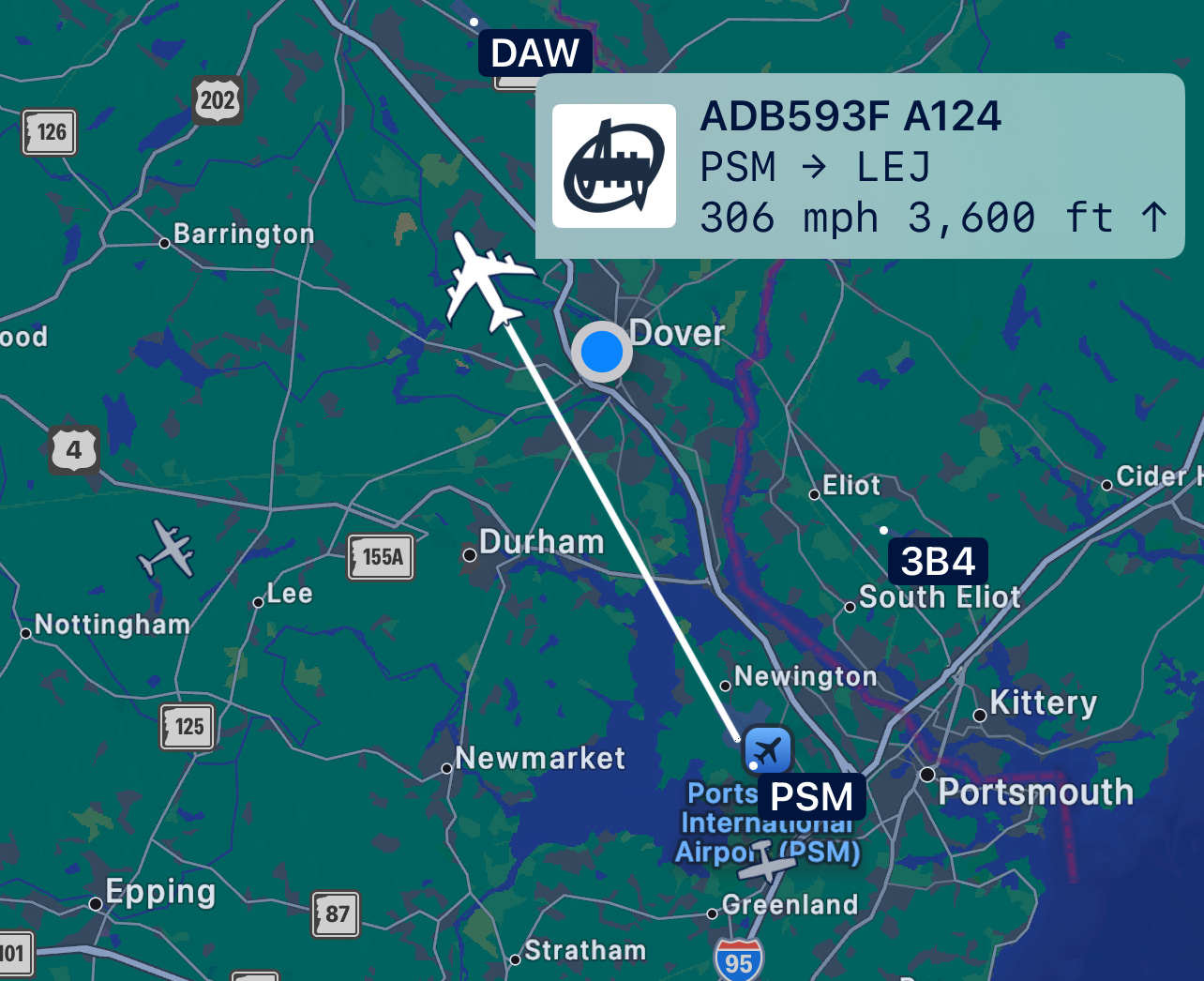
A bit more research revealed that it was an Antonov An-124, departing Pease and heading for Leipzig in Germany.
When one (or at least, when I) hears of an Antonov cargo airplane, they think of the legendary Antonov An-225. It was once the largest plane in the world. There was only one of them ever completed, and tragically it was destroyed on the first day of the Russian invasion of Ukraine back in 2022.
The An-225 was based on the An-124 design that I saw in the air that day. It was stretched a bit, and its four engines upped to six (We’re going around! Everyone grab a throttle!). For years, the An-225 carried large cargo items all over the world. We even got to see it in person a few times at the EAA show in Oshkosh.
But now Antonov’s big design is the An-124. It is now the biggest cargo plane in the world.
Telling my experience to an airplane friend we fantasized that this plane was carrying urgent war supplies to the people of Ukraine. We envisioned that after the stop in Germany it would continue on to Kyiv to deliver these valuable materials. But this dream was not to become real.
After Leipzig, according to FlightAware, the plane continued on to Athens, where it remained for the next few days.
I see interesting aircraft in the sky above Dover all the time. I’ve talked on the podcast about fighters, tankers, C-5 cargo planes, ultralights, and even one time one of the planes which operates as Air Force One.
But today it was one of the handful of Antonov An-124s that carry cargo all around the world.
[Jack]
This Year’s Bizav Show Didn’t Disappoint
The National Business Aviation Association (NBAA) held its 2025 Business Aviation Convention & Exhibition (BACE) at the Las Vegas Convention Center and nearby Henderson Executive Airport in mid-October, showcasing an industry the association said is “driven by strong growth and a blazing pace of innovation.”
The event opened as Honeywell Aerospace Technologies released its 2025 Global Business Aviation Outlook, its 33rd annual industry forecast, which helped set the show’s mood by projecting demand for 8500 new business jet deliveries valued at $280 billion through the next decade.
Of that forecast total, “Large jets are expected to account for about two-thirds of all expenditures of new business jets in the next five years,” which Honeywell said is consistent with last year’s results. The forecast is driven by “extensive surveys of business aviation operators across the globe.” Honeywell said more than 90% of survey respondents expected to fly more or about the same this year as they did in 2024. Separately, Global Jet Capital, a financial advisor focused on the business aircraft market, chimed in, projecting a $40 billion bizjet market this year alone.
“The business aviation industry is in a prolonged period of healthy growth, and we don’t see that positive trend changing any time soon,” said Heath Patrick, president, Americas Aftermarket, Honeywell Aerospace Technologies. “Business aviation continues to see more users and, as a result, manufacturers are ramping up production to keep pace with growing demand, a trend we expect to continue for the foreseeable future. Despite a mixed macroeconomic environment and challenging geopolitical circumstances, operators are optimistic about their flight activity increasing in 2025 and beyond.”

Some of the highlights at this year’s event include Bombardier establishing a new top speed - Mach 0.95 - for its flagship Global 8000 bizjet, making it the fastest certified civil aircraft, a title held for a number of years by Cessna’s Citation X at Mach 0.935. Meanwhile, Bombardier competitor Gulfstream Aerospace brought a mock-up of its forthcoming G300 super-midsize jet, which it had announced only two weeks earlier. The G300 is a follow-on model derived from the popular G280 and, like the G280, is to be built under license by Israeli Aircraft Industries in Tel Aviv.

Another bit of news was made by Otto Aerospace and its planned Phantom 3500, which included a mockup at this year’s show. In September, Otto raised a few eyebrows with its sleek design, which features a windowless cabin lined with video screens driven by cameras mounted externally. Upon its introduction, Otto Aerospace also announced a “firm” order from fractional operator Flexjet for 300 copies of the yet-to-be-flown twinjet, raising a few more eyebrows. The Phantom 3500’s first flight is set for 2027, with deliveries to follow beginning in 2030.
“The 2025 NBAA-BACE fired the imagination, inspired an industry and highlighted the breakthroughs and pioneers ushering in a bright new era in business aviation,” said NBAA President and CEO Ed Bolen. “Business was conducted and connections made. This show had a tremendous vibe.”
[Jeb]
This newsletter, and the OG audio podcast are, and always will be, free for all. But it takes some time and concentration for us to make them. And we’d like to be able to dedicate even more time and resources to doing them. We’re asking you to consider becoming a financial supporter of what we’re doing.
If you’re unable to make any sort of financial contribution to the UCAP world, we understand. Don’t worry, and please enjoy it all. But if you have the ability to support what we’re doing, please consider doing so.
A monthly donation of as little as $5 — less than a single visit to Starbucks — is a big show of support for what we’re doing. Please go to our Patreon page and do what you can.
Thanks.
Just Bad Luck
Last week a Boeing 747 freighter swerved off the runway at Hong Kong International Airport, crossed the perimeter road, and ended up in the shallow waters that surrounds the airport.
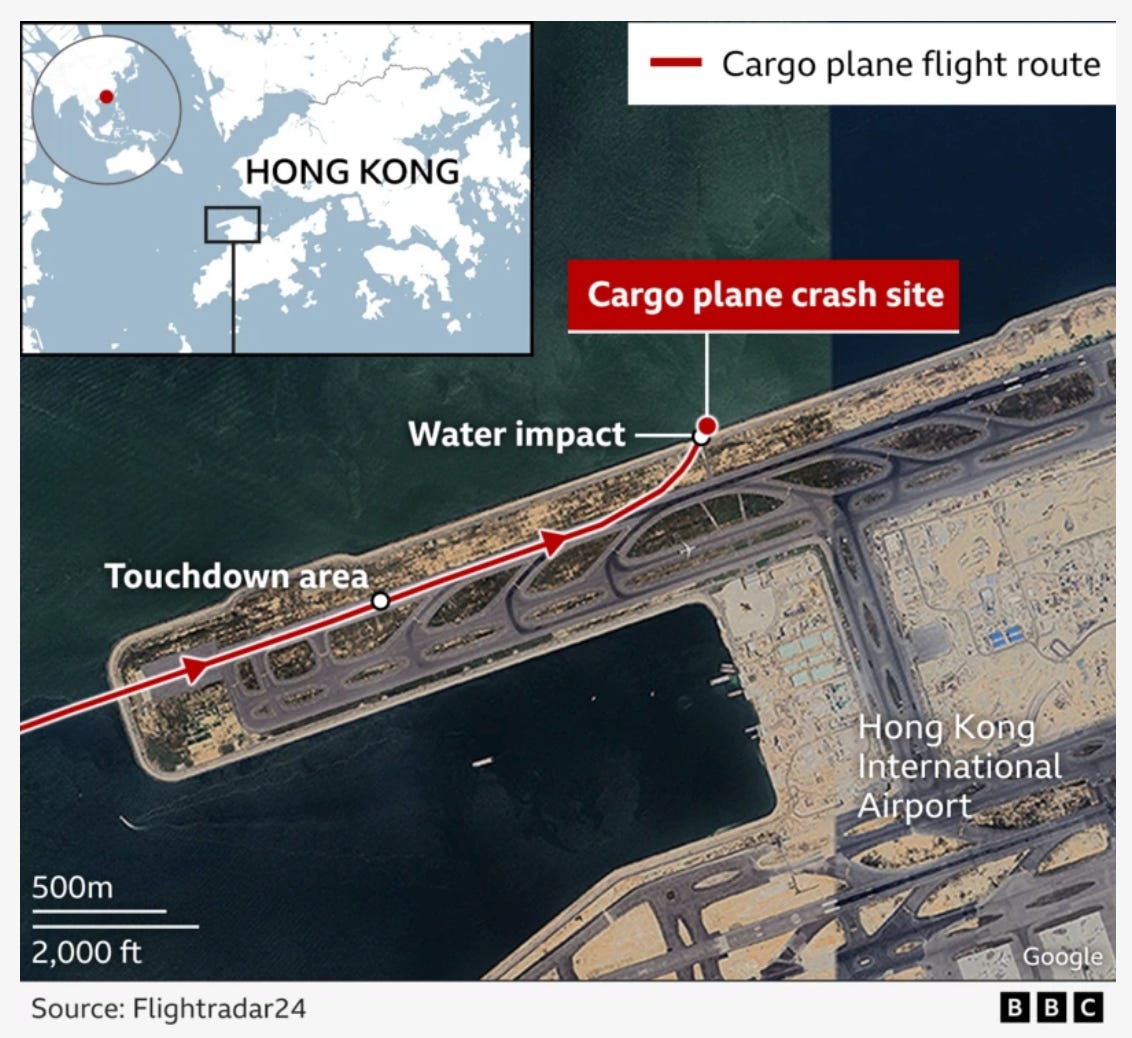
The crew of the Boing jumbo survived, but tragically, two airport security guards, driving on the airport perimeter road, were struck by the out-of-control plane, and their vehicle was flung into the water where they both died.
We know from experience that accidents are usually the result of a chain of many small, poor choices, and that the tragic ending might be avoided with one slight correction. But as we see in this Hong Kong event, the calamities are sometimes made worse because they happened at exactly the wrong moment.
We saw this many years back when a Reno race plane suffered a flight controls malfunction and loss of control, in the only few seconds of the race lap which could result in the plane going into the spectator crowd. It was a grizzly tragedy, which took 11 lives, but cruel reality was that if the controls failure had happened a few seconds earlier or later, the plane would have ended up in an unoccupied area of the race grounds.
In Hong Kong, I look at the overhead view of the accident scene and I envision a pair of security guards, quietly doing their rounds, driving on a remote part of the perimeter road, when a 747 comes careening off the runway to exactly the spot where they happen to be. Just the worst of bad luck.
So we still need to be on the lookout for that chain of events that might lead to a serious accident. But maybe we need to be carrying our rabbit’s foot too.
BBC story about the crash.
[Jack]
First Solo
This past Monday October 27 was the 36th anniversary of my first solo.
On that day in 1989 my instructor Jeff A. (I remember his last name, but privacy) and I had been doing pattern work at Palo Alto Airport in California when, taxiing back, he told me to pull off onto a less busy taxiway, he got out, and said, do three takeoffs and landings. Big moment.
Although I remember my pulse going up a bit, it really wasn’t a big surprise. I’d been expecting him to set me loose for a few lessons. When I’d hint at it, he’d just say some form of, “not yet.”
But now was the time.
In truth I don’t really remember many details of this moment. But a few things have always shined bright in my memory.
The first was how quickly the plane climbed. I’d done a lot of takeoffs with Jeff sitting next to me in these little Cessna 150s. So I knew what to expect in the climb out. I was familiar with what landmarks we’d reach by the time we needed to turn crosswind, and where we’d be when we reached pattern altitude. But this time, wow. I knew it would climb faster, and it did!
The other thing that I’ve always remembered flying alone for the first time was how, although I felt confident in the plane, I also still heard Jeff talking to me at key moments. “Watch your airspeed.” “Do you need more flaps?” “You got this.”
When I glanced to the ground I could see him standing by the taxiway bench, watching me intently, but it still felt like he was with me. Except for the reduced weight thing.
I did my three times around the pattern, and taxied back to where Jeff had been standing. He signaled me to taxi to our parking, where he met me with a big grin on his face. Almost as if it was a big moment for him too.
It was a few more lessons before Jeff signed me off to solo without him supervising, but it came eventually.
Due to a variety of factors it was a while before I completed my primary training and did my check-ride. By that time I had had two other CFIs. Jeff had gotten the call and moved up to the “big show” of the airline job he’d been dreaming of, and another CFI had to leave me due to a day-job change. But I learned new things from all my CFIs and eventually got my private pilot license.
But it was on that day, 36 years ago when I first flew as the only soul on board, and in my view, that’s when I became a Pilot.
Memories.
[Jack]
That’s it for Vectors 112. Please tell your friends about this newsletter, and post your comments about these stories and others you like to read about here.
UCAP Vectors, Issue 112 is copyright (c) 2025 UncontrolledAirspace.com
Hey Jack, I saw the Antonov on arrival to Pease in Concord NH that day... Had to pull up flight aware to figure out what the heck that was.
Rick