


It’s been an interesting winter for the UCAP gang. Jack has been on the road a good bit, and finds that each time he flies out of KBOS to travel for work, he has to battle through a major snowstorm to catch his flight. Meanwhile, Jeb had to turn on his home’s heat a couple of times, but doesn’t really think his experience compares to Jack’s. Jeb also spent a good portion of his winter doing some advanced flight training, along with frequent UCAP guest Steve Tupper, which was a major topic of a recent podcast episode.
Meanwhile, both Jack and Jeb are gearing up for the upcoming air shows, starting with our annual pilgrimage to Lakeland, FL, for the Sun `n Fun Fly-In. Once again, we’ll be live from the deck at SnF Radio, and Jack will be a daily co-host for the station’s morning air show coverage. Along the way, we’ll also crank out a few podcasts.
Until then, sit back, put your feet up and enjoy this latest issue of our newsletter!

2025 Was A Pretty Good Year (For New-Airplane Sales)
As long as I’ve been aware of and involved in general aviation — which spans a few decades — pilots and aircraft owners have despaired about the industry’s fate. Student starts and completions rise and fall, as do accident rates (although they have been on a fairly consistent downward trend in recent years). New aircraft are out of cost-effective reach for most individuals, but not businesses and corporations. Fuel prices are always a topic of discussion in our virtual hangar and maintenance expenses likely will seem higher than they were the last time your airplane was in the shop. Of course, that presumes you can even find a shop willing to work on your flivver, which is a whole ‘nuther topic.
Despite those and many other challenges, the General Aviation Manufacturers Association (GAMA) recently posted some very good sales numbers for the last calendar year. According to the organization, “The state of the general aviation manufacturing industry remains steadfast. We continue to see robust numbers of total aircraft delivered as well as annual billings eclipsing $35 billion, the highest it has ever been.”
New airplane deliveries of all kinds in 2025 totaled 3,230, roughly half of which were business jets. Deliveries of piston airplanes inched up by 10, while the number of new turboprops fell by roughly five percent. Overall airplane shipments were up by 2.2 percent when compared with 2024. Given the higher numbers of jet delivered, you’d expect billings to be up, also, and you’d be correct: According to GAMA, the value of new-airplane billings was $31 billion, an increase of almost $5 billion. Yes, with a “b”.
Meanwhile rotorcraft shipments declined slightly, from 956 in 2024 to 938 last year, a drop of 1.9%, but billings also increased, from $4.5 billion in 2024 to $4.7 billion in 2025.
[Jeb]
The Swiss Cheese Holes Align Once Again
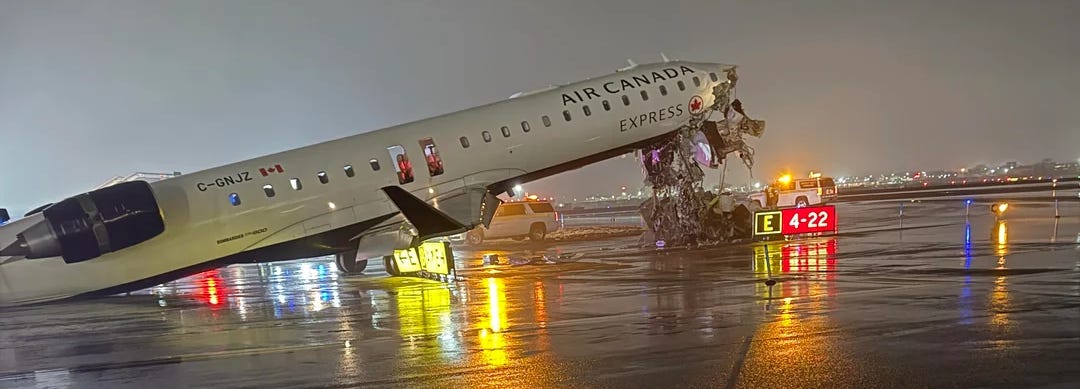
The Sunday, March 22, 2026, collision at New York’s LaGuardia Airport (KLGA) is one of those basic things that isn’t supposed to happen in the national airspace system. An arriving Air Canada Express CRJ-900, operated by Jazz Aviation as Flight 8646, collided on Runway 4 with an airport firetruck responding to an unrelated call.
Both pilots were killed and dozens aboard the plane were injured. According to the Associated Press, a strapped-in flight attendant was separated from the airplane came to rest “far from the site of the crash,” still secured to her seat. At least two aboard the firetruck were injured.
The New York Port Authority closed the airport to all traffic after the accident, another disruption — along with unpaid TSA employees at airline airports and spiking fuel costs — to the nation’s fragile air transportation system. The airport had reopened, at least partially, by mid-afternoon Monday.
This is where we remind readers there’s still a shortage of air traffic controllers — somewhere between 3000 and 4000, depending on when and by whom the numbers are being crunched.
[Jeb]
Thanks for reading UCAP Vectors! Subscribe for free to receive new posts and support our work.
This newsletter, and the OG audio podcast are, and always will be, free for all. But it takes some time and concentration for us to make them. And we’d like to be able to dedicate even more time and resources to doing them. We’re asking you to consider becoming a financial supporter of what we’re doing.
If you’re unable to make any sort of financial contribution to the UCAP world, we understand. Don’t worry, and please enjoy it all. But if you have the ability to support what we’re doing, please consider doing so.
A monthly donation of as little as $5 — less than a single visit to Starbucks — is a big show of support for what we’re doing. Please go to our Patreon page and do what you can.
Thanks.
AOPA At A Crossroads: Leadership Drama

The first AOPA president I met was John Baker, back in the 1970s. I had already joined the association and was still learning how to use my private ticket. He was the organization’s second president, following J.B. "Doc" Hartranft, who also holds the distinction of being AOPA’s first employee. Phil Boyer followed in 1991 when Baker retired, and then Craig Fuller and Mark Baker served in the role. In early 2025, Darren Pleasance took over the reins as president and CEO, and — judged by the membership uproar last month when he was essentially fired by AOPA’s board of trustees — was much admired among the association’s membership. The board of trustees? Maybe not so much.
The specific reasons for Pleasance’s seemingly abrupt departure after barely a year in the position were difficult to nail down, but it’s clear there was a conflict between him and the board. Some observers say it stemmed from Pleasance’s commuting from his home on the west coast, but he had just bought a home in Frederick, MD, AOPA’s headquarters. One thing for sure is that Pleasance spent a lot of time on the road and was popular among the membership, which some on the board may have perceived as threatening.
Meanwhile, the organization is being run by acting co-presidents: AOPA’s Chief Financial Officer Jill Baker and Katie Pribyl, Senior Vice President of Membership Strategy and Growth, are in everyday charge. Both acting co-presidents have deep roots in the general aviation industry and senior management experience at the association. As Pribyl wrote in the association’s flagship magazine, “This is a period of transition for AOPA. Transitions, especially unexpected ones, can bring questions. But rest assured that our commitment to serving our members—and all GA pilots—will never change. As for the path forward, it’s all about our members and our mission—work that is more critical than ever.”

As it announced Pleasance was leaving day-to-day operations and stepping into an advisory role, the association’s board of trustees added it would “initiate a formal search shortly for the next President and CEO. The process will be designed to be thoughtful, inclusive, and aligned with the long-term needs of AOPA’s members and the general aviation community.”
Then it got interesting. A new organization popped up — SaveAOPA.org — which billed itself as “A grassroots movement of concerned AOPA members, pilots, and aviation enthusiasts dedicated to reforming the organization and restoring its mission to serve general aviation.” According to Russ Niles at AvBrief.com, the new group was focusing on AOPA’s May 12 annual meeting as a first step in reforming the association.
But on March 19, the SaveAOPA site was taken down. According to AvBrief.com, that came after AOPA’s new general counsel, Fernando Campoamor Sanchez, pointed out to one of SaveAOPA’s principals, Peter Bowers, the former owner of WACO Aircraft and a recent vice president at AOPA, that his participation in SaveAOPA was at odds with a separation agreement between Bowers and AOPA.
On Saturday, March 21, the SaveAOPA.org web site simply read “You're Welcome” and included an email address for more information. On Monday, March 23, it was simply a mocked-up taxiway sign, reading “AV8R.”
As if all that upheaval wasn’t enough, AOPA Chairman Jim Hauslein, announced March 20 that the board of trustees elected Luke Wippler to succeed him as chairman. Additionally, Hauslin said he and former Chairman Bill Trimble will not “stand for reelection to the board at the May annual meeting.”
Regardless of whether you’re an AOPA member, or your opinion of the organization, this kind of upheaval and uncertainty in one of the industry’s long-standing institutions isn’t constructive. But with so many of the nation’s institutions falling down on the job, did we really think general aviation would be immune?
In an apparently unrelated development, popcorn futures reportedly are rising in value. Beware the Ides of May.
[Jeb]

Meanwhile, A Quick Plug For Our Friends At AvBrief
If you weren’t aware, long-standing aviation web site AVweb.com, went through its own upheaval in late 2025. (Disclaimer: I had a long association with AVweb, beginning in the 1990s and extending well into the 21st century.) One result was the departure of long-time editor Russ Niles and arrival of a new crop of people, along with some AI-produced content.
Russ and a handful of what I’ll respectfully label the “Belvoir Mafia”—some AVweb contributors, plus Aviation Consumer magazine editor Larry Anglisano and others—have relocated to a brand-new aviation site, AvBrief.com. AVweb, Aviation Consumer magazine and my former day job, Aviation Safety magazine, formerly were members of the Belvoir Media Group.
After starting up the new outlet from scratch over a single weekend, AvBrief is starting to find its stride, mixing in a daily dose of general-purpose aviation news with weekly features on smart ownership, instrument flying and the experimental/homebuilt market. If you haven’t checked it out, do so. If you have, what do you think?
[Jeb]
The Sky is Getting Crowded — And It’s Only Going to Get Worse
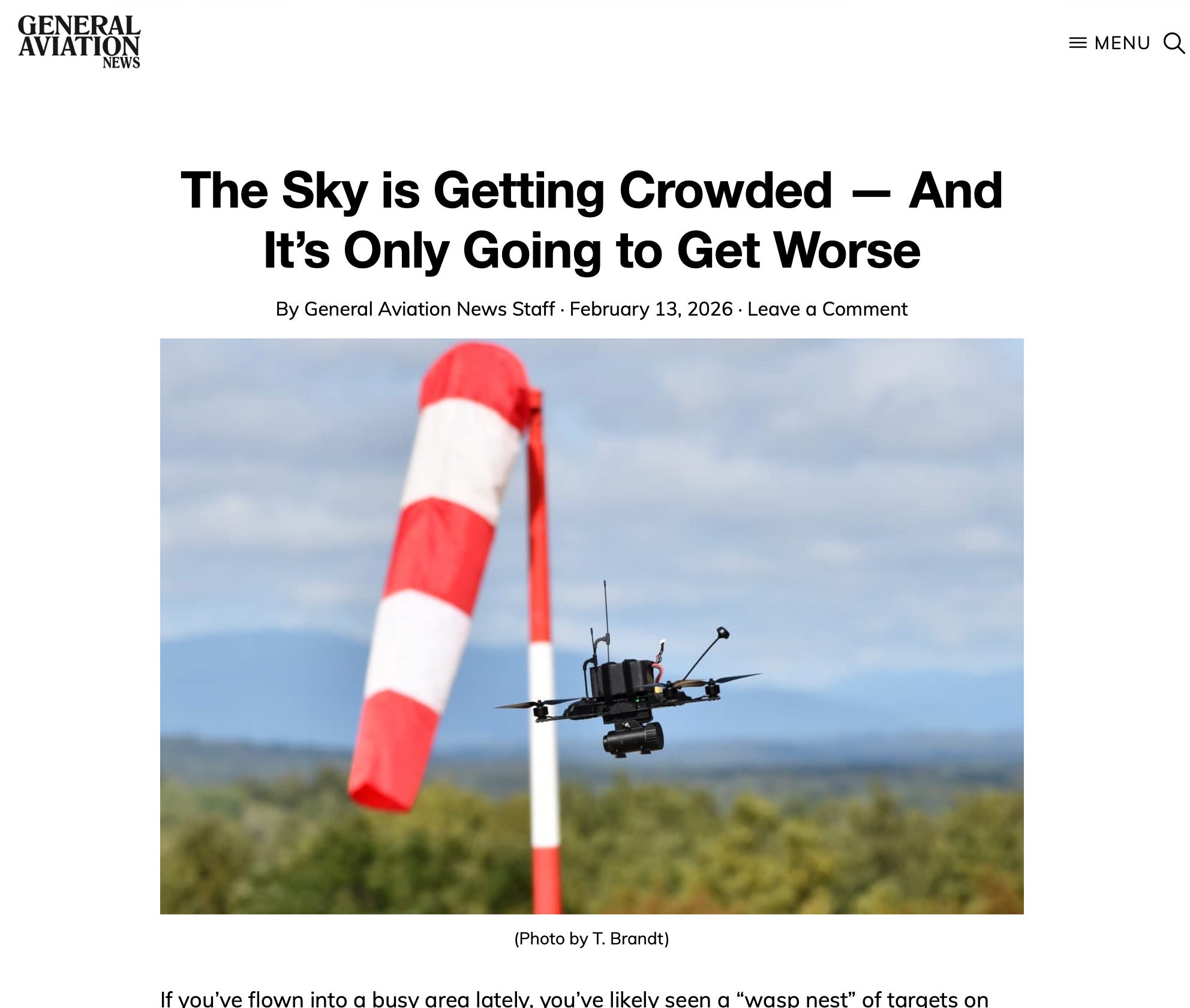
The large number of general aviation, and other aircraft with humans on board, around us in the skies today can present a significant challenge. But the crowding of the skies is poised to get much much worse.
It is estimated that in the near future there could be over 3 million commercial and recreational “drones” in U.S. airspace. And there are very few system requirements to enable all these aircraft able to “see” and avoid each other.
Read more in this General Aviation News story.
]Jack]
An Aviation Love Story
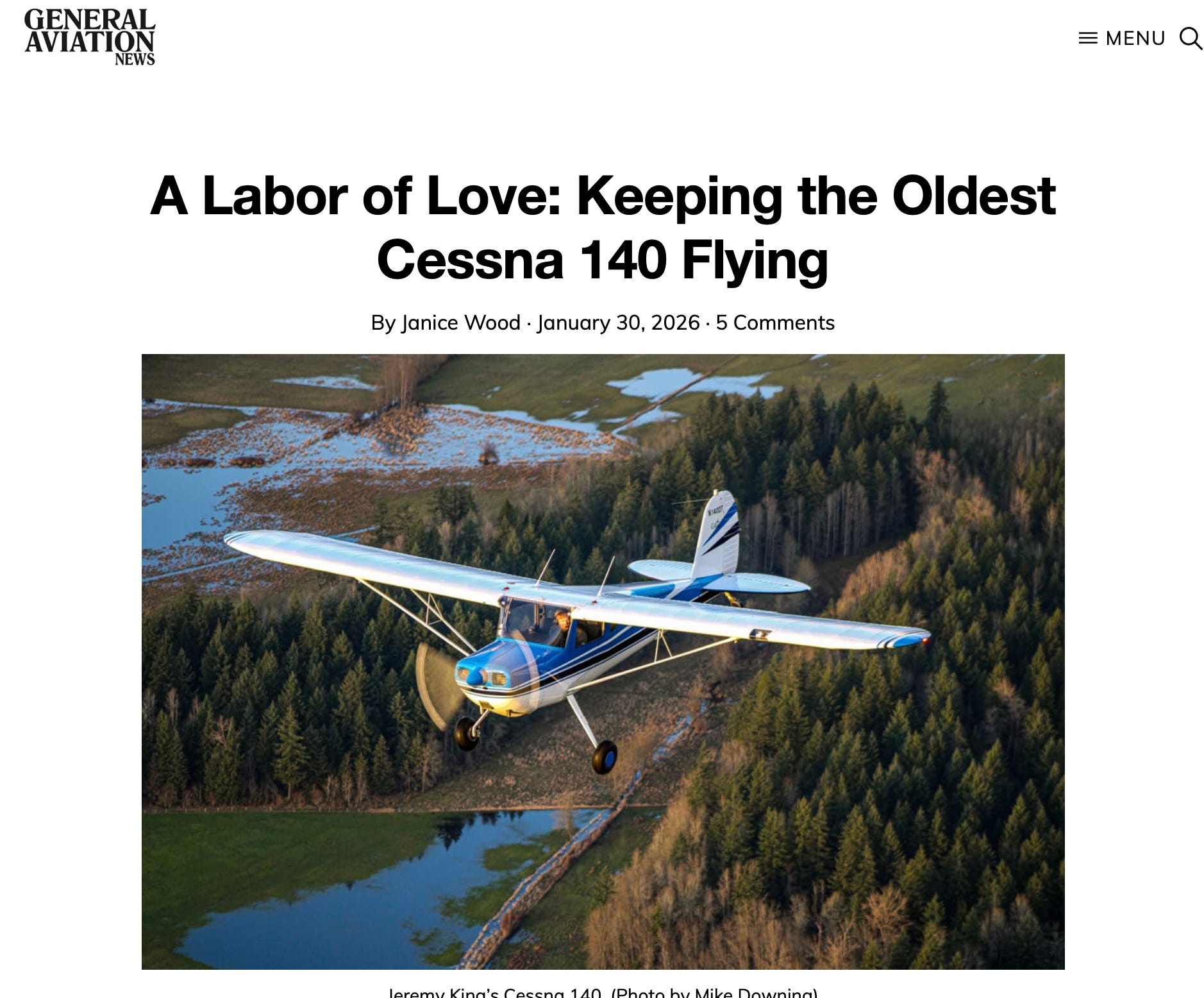
Cessna 140 serial number 8006 has had quite a journey, and it’s not over yet.
Jeremy King of Rainier, Washington had always loved the 140, so when he had a chance to buy one he jumped, and only afterward did he realize the little treasure he’d acquired.
He was a student pilot when he heard about this 140. He bought it and then the fun began. He found a hangar for it. Managed to give it some needed TLC. And found a CFI who loved the 140 as much as he did.
“It doesn’t have all the engineering designed into it, so you really have to fly the plane — it doesn’t fly for you,” King said. “At the same time it’s forgiving and gentle.”
The serial number, 8006, actually means that it was the sixth instance off the production line. And the first five have long since stopped flying. So this is the oldest still-flying 140.
King has traced much of the history of his plane, which includes multiple owners and a lot of ups and downs.
In June 2025 King earned his private ticket in his little treasure.
There’s a lot more to this story, which you can read in this GANews piece.
[Jack]
The U.S. Army Is Trying To Weasel Out Of The NTSB’s ADS-B Recommendations
“Systemic failures in airspace design, safety oversight, and risk management by the Federal Aviation Administration and the U.S. Army” contributed to the January 29, 2025, midair collision that killed all 67 aboard both aircraft, the National Transportation Safety Board (NTSB) said in January before releasing its final report on the tragedy. The collision occurred over the Potomac River, less than a mile from the Runway 33 threshold at Washington National Airport (KDCA), and involved PSA Airlines Flight 5342, operated by a Mitsubishi Heavy Industries CRJ700 regional jet and a U.S. Army Sikorsky UH-60LI conducting a training flight. It was the deadliest aviation accident in U.S. airspace since November 2001.
The NTSB’s final report makes 33 recommendations to the FAA, eight recommendations to the US Army, five recommendations to the Department of War Policy Board on Federal Aviation, two recommendations to the Department of Transportation (DOT), one to the DOT Office of the Inspector General and one to the RTCA. Implementing those recommendations — at least as it involves the FAA and the U.S Army — has become a political football, as these things too often do.
At this time, legislation to implement some of the recommendations is stalled in Congress, thanks to a policy flip-flop by the U.S. Army regarding ADS-B. Late last year, the U.S. Senate unanimously passed — how often does that happen? — the so-called ROTOR Act (S. 2503), sending it to the House of Representatives. After its passage, according to NPR, “Pentagon spokesman Sean Parnell said in a statement that the bill could create ‘unresolved budgetary burdens and operational security risks,’ though he did not specify what they are.”
On February 24, 2026, the House narrowly declined to approve that bill, thanks at least in part to the Army’s change of heart regarding its ADS-B provisions, which would mandate the In and Out versions of the technology aboard all aircraft in airspace where all other operators are supposed to use it.
According to a letter from NTSB Chairwoman Jennifer Homendy, along with board members Michael Graham, Tom Chapman and Todd Inman, the House version, dubbed the ALERT Act (H.R. 7613), “is inferior to the ROTOR Act because of its watered-down ADS-B provisions.” In essence, the ROTOR Act mandates the Traffic Information Service of ADS—B In but the ALERT Act would not.
How all this gets sorted out remains to be seen. One would think that the Pentagon maybe could use some of its $200 billion Iran War spending request to spring for a few iPads and portable ADS-B In receivers.
[Jeb}
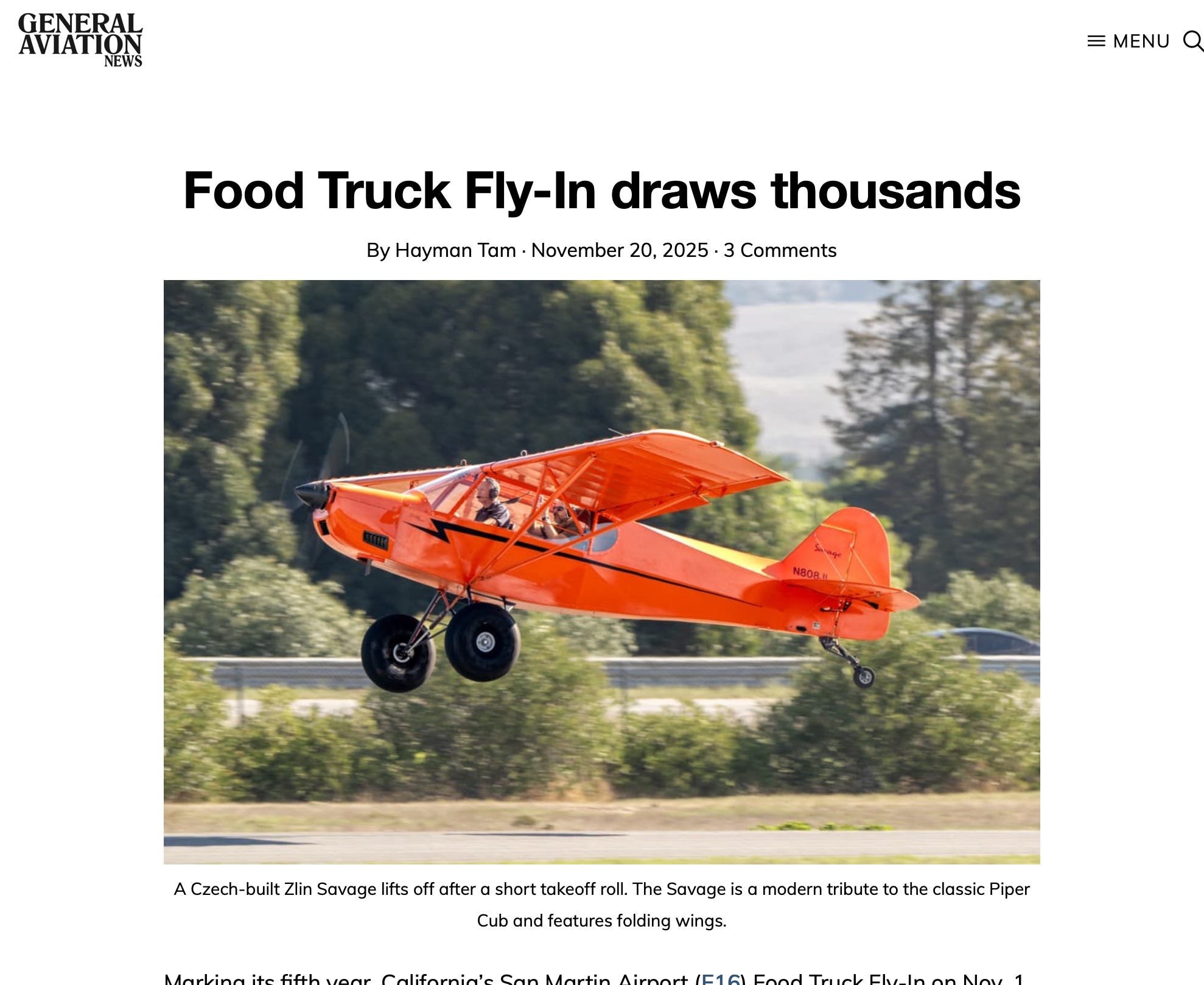
In an earlier life I was a volunteer events coordinator for an aviation museum located at what we then called “South County Airport” near San Jose in California.
We put on “airport day” type gatherings: pancake breakfasts, EAA Young Eagle days, fundraising dinners, even the occasional light fly-by shows.
Since I left, they’ve apparently moved on to even bigger and better airport gatherings. This “Food Truck Fly-In” event sounds fantastic. I’ll have to plan one of my west coast visits around a future one of these. Check out the story here.
[Jack]
Weird Story About A Cow And An Airplane

As we’ve reported many times in this newsletter and on the podcast, the history of aviation contains some very odd events. I wouldn’t have it any other way.
We’ve all heard of National Cheeseburger Day, Pancake Day, Flag Day, Presidents Day, and many others. But how about “Cow Milked While Flying in an Airplane Day”. For real.
On February 18, 1930, a cow named “Elm Farm Ollie”, aka “Nellie Jay” became the first cow to fly in an airplane. This exciting occasion also included the indignity (or pleasure, I suppose, maybe) of being milked during the flight.
I can’t make this stuff up. Wikipedia
There’s even a page for ways to celebrate this holiday.
[Jack]
Please look around your seat for any personal belongings before deplaning Vectors 115. Please also tell your friends about this newsletter, and post your comments about these stories and others you’d like to read about here.
Thanks for the news about AvBrief! I appreciate having a daily and decent source of aviation news and info. Shame about AvWeb demise.